
Pensions, Maternity Leave and Insurance; Legal Changes Employers Must Understand in 2025
Rwanda’s labour and social protection framework has undergone significant evolution over the past decade. With the combined effect of the Law N°66/2018 regulating labour in Rwanda and various ministerial orders issued by MIFOTRA, employers now operate under a more structured, more protective, and more demanding system. These reforms touching pensions, maternity leave, and insurance schemes reflect the country’s ambition to safeguard workers while strengthening long-term economic resilience.
For businesses, these changes bring benefits but also responsibilities. Understanding what the law required before and what it requires now is essential, especially for organisations aiming to remain compliant, competitive, and socially responsible.
1. The Legal Context: A Framework Built for Modern Employment
Law N°66/2018 serves as the core of Rwanda’s labour regime. It establishes the rights and obligations of employers and employees, including rules on employment contracts, working hours, leave entitlements, occupational safety, and termination. Complementing this law, the Ministerial Order N°02/MIFOTRA/22 of 30/08/2022 clarifies several aspects of employment conditions, including leave procedures and workplace health and safety obligations.
Before these reforms, Rwanda’s labour framework was more fragmented. Employers often relied on dispersed directives, and the interpretation of certain rights particularly social protections was inconsistent. Today, the regulatory environment is more coherent: obligations are more precise, sanctions clearer, and social rights more enforceable.
2. Pension Reform: Strengthening the Foundation of Long-Term Social Security
What the Law Provided Before
Prior to recent updates, the pension system managed by the Rwanda Social Security Board (RSSB) operated under relatively static contribution rates. Both employees and employers contributed to the mandatory pension scheme—commonly at a combined rate of 8% of the employee’s salary (typically 3% paid by the employee and 5% by the employer). The contribution structure had remained unchanged for many years, even as Rwanda’s labour market expanded and demographic patterns shifted.
Administrative procedures were also more manual. Employers routinely submitted declarations offline or through semi-automated systems, and compliance monitoring was less stringent.
What Has Changed
Recent reforms introduced through administrative instructions and updates to social security regulations have adjusted pension contribution obligations and strengthened compliance procedures. The government has progressively moved toward increasing contribution rates to ensure the sustainability of the pension fund. Although the percentage changes have been gradual, the shift reflects a policy direction aimed at long-term solvency as life expectancy increases.
The reforms have also made digital reporting mandatory. Employers are now required to declare their employees and pay pension contributions through fully digital RSSB platforms. This reduces errors, improves traceability, and facilitates audits.
Practical Implications for Employers
The changes mean that employers must now update payroll systems, recalculate contribution shares, and maintain clear employee records. Employment contracts must reflect correct contribution rates, and HR teams must prepare for more comprehensive RSSB audits. The financial impact, while manageable, requires planning—especially for companies with large workforces.
3. Maternity Leave: A More Protective System for Working Mothers
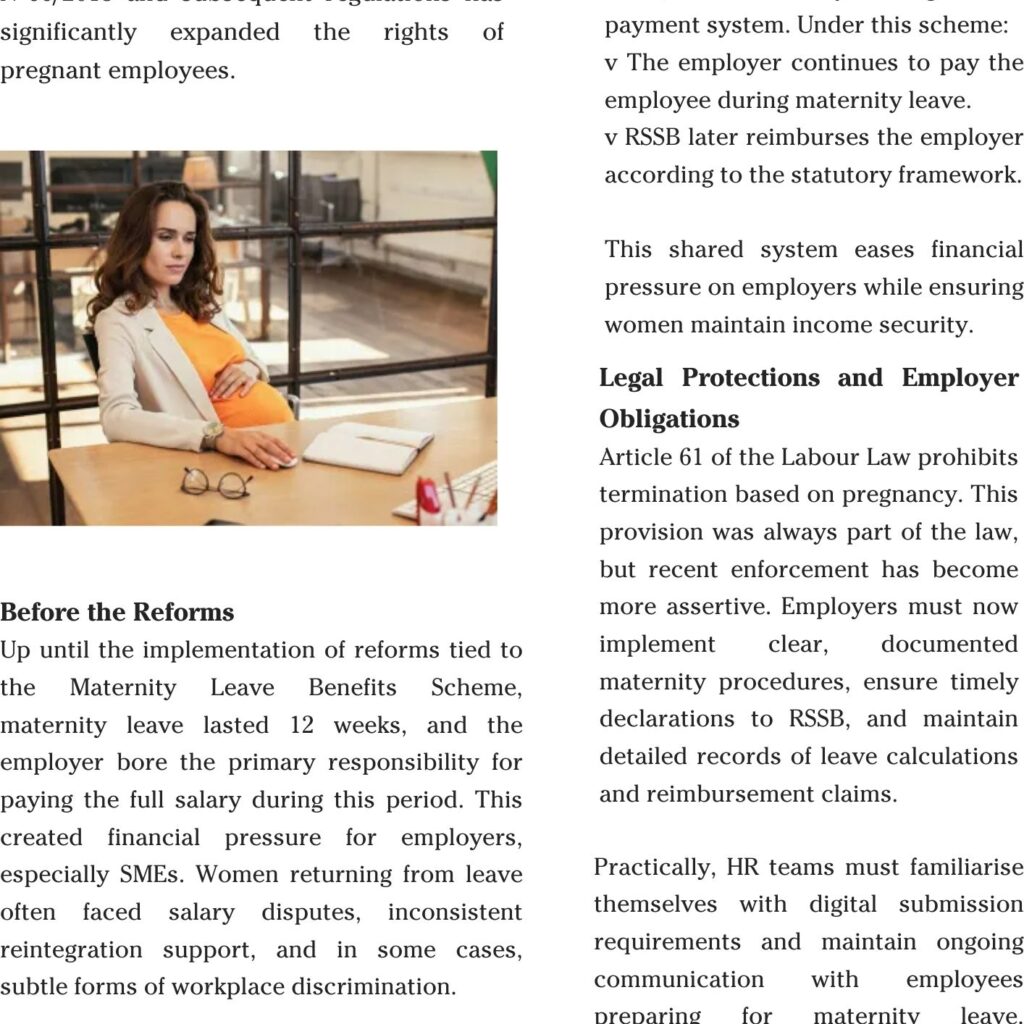
Few areas of labour law have evolved in Rwanda as visibly as maternity protection. The combination of Article 58 of Law N°66/2018 and subsequent regulations has significantly expanded the rights of pregnant employees.
Before the Reforms
Up until the implementation of reforms tied to the Maternity Leave Benefits Scheme, maternity leave lasted 12 weeks, and the employer bore the primary responsibility for paying the full salary during this period. This created financial pressure for employers, especially SMEs. Women returning from leave often faced salary disputes, inconsistent reintegration support, and in some cases, subtle forms of workplace discrimination.
What Has Changed
Today, maternity leave in Rwanda stands at 14 weeks (98 days). This adjustment aligns the country with international best practices and significantly strengthens the stability of women’s employment.
The creation of the Maternity Leave Benefits Scheme, administered by RSSB, fundamentally changed the payment system. Under this scheme:
- The employer continues to pay the employee during maternity leave.
- RSSB later reimburses the employer according to the statutory framework.
This shared system eases financial pressure on employers while ensuring women maintain income security.
Legal Protections and Employer Obligations
Article 61 of the Labour Law prohibits termination based on pregnancy. This provision was always part of the law, but recent enforcement has become more assertive. Employers must now implement clear, documented maternity procedures, ensure timely declarations to RSSB, and maintain detailed records of leave calculations and reimbursement claims.
Practically, HR teams must familiarise themselves with digital submission requirements and maintain ongoing communication with employees preparing for maternity leave. Reintegration after maternity leave also carries legal significance, as demoting or refusing to reinstate a returning employee can trigger legal liability.
4. Insurance and Broader Social Protection: A More Comprehensive System
Rwanda’s social security architecture has broadened over the years to cover several areas beyond pensions and maternity. Through RSSB, employees may benefit from medical insurance, occupational hazard coverage, and other protection mechanisms.
How the System Worked Before
Historically, registration and contribution compliance for these schemes varied widely among employers. Many small companies delayed employee registration, and manual reporting created inconsistencies in employee records. Coverage for occupational hazards was not always well understood, leading to disputes between injured employees and employers.
What Has Changed
Recent reforms both administrative and regulatory have firmly linked employee insurance obligations to employer compliance. Digitalisation has made it easier for RSSB to detect late declarations. Contribution deadlines are now strictly enforced, and penalties for late payments or non-registration have become more significant.
The Ministerial Order N°02/MIFOTRA/22 reinforces the obligation of employers to maintain safe workplaces and to report occupational hazards promptly. Employers are encouraged to integrate health and safety compliance into their HR planning rather than treat it as a peripheral obligation.
Additionally, the government’s push for digital health insurance management means employers must maintain updated employee data and promptly notify RSSB of new hires or departures.
What This Means for Employers
Organisations must integrate social protection compliance into their standard HR processes. This includes accurate monthly declarations, real-time updates on employee changes, and routine internal audits to verify that contribution payments match employee records. Given that these systems increasingly interact with immigration, tax, and business licensing platforms, compliance is now more interconnected than ever before.
5. The Economic and Social Impact of the Reforms
The modernization of pensions, maternity leave, and insurance obligations has had a broad economic and social impact. For employees, the reforms increase financial stability, protect income, and promote workplace equality particularly for women. The extended maternity leave period and state-supported payment model reduce the likelihood that working mothers will face discrimination or income loss.
For employers, the reforms require more structured HR systems and more disciplined payroll management. While contribution adjustments may increase short-term personnel costs, they reduce long-term legal risks and improve employee retention. Companies known for compliance and fair labour practices are more likely to attract investment, especially as due diligence in Rwanda increasingly focuses on labour obligations and social insurance records.
The wider economy benefits from a population that is better protected and more productive. Strong social protection systems reduce poverty risks, increase workforce stability, and contribute to the country’s long-term development strategy.
6. Key Compliance Actions for Employers
To remain compliant with the updated framework, employers should take the following steps:
- Ensure all employees are registered with RSSB immediately upon hiring.
- Update payroll systems to reflect revised pension contribution rates.
- Review employment contracts and HR manuals to incorporate legal maternity provisions.
- Submit monthly declarations through RSSB digital platforms and maintain evidence of payment.
- Train managers on maternity rights, anti-discrimination rules, and occupational safety obligations.
- Conduct internal labour compliance audits at least once a year.
Conclusion
Rwanda’s labour and social protection reforms mark an important transformation in how the country regulates work and protects its workforce. Pensions are becoming more sustainable, maternity protections more equitable, and insurance systems more reliable. These changes support the country’s ambition to create a modern, inclusive, and resilient economy.
For employers, adapting to this evolving framework is not only a legal obligation it is an investment in stability, reputation, and employee welfare. Companies that prioritise compliance today will build stronger, more sustainable businesses tomorrow.