
Introduction
The African Continental Free Trade Area (AfCFTA) entered into force on 30 May 2019 and has been operational since 1 January 2021. It aims to progressively create an integrated continental market for goods and services, serving more than one billion consumers. Yet the existence of a common legal framework does not, on its own, guarantee effective commercial integration.
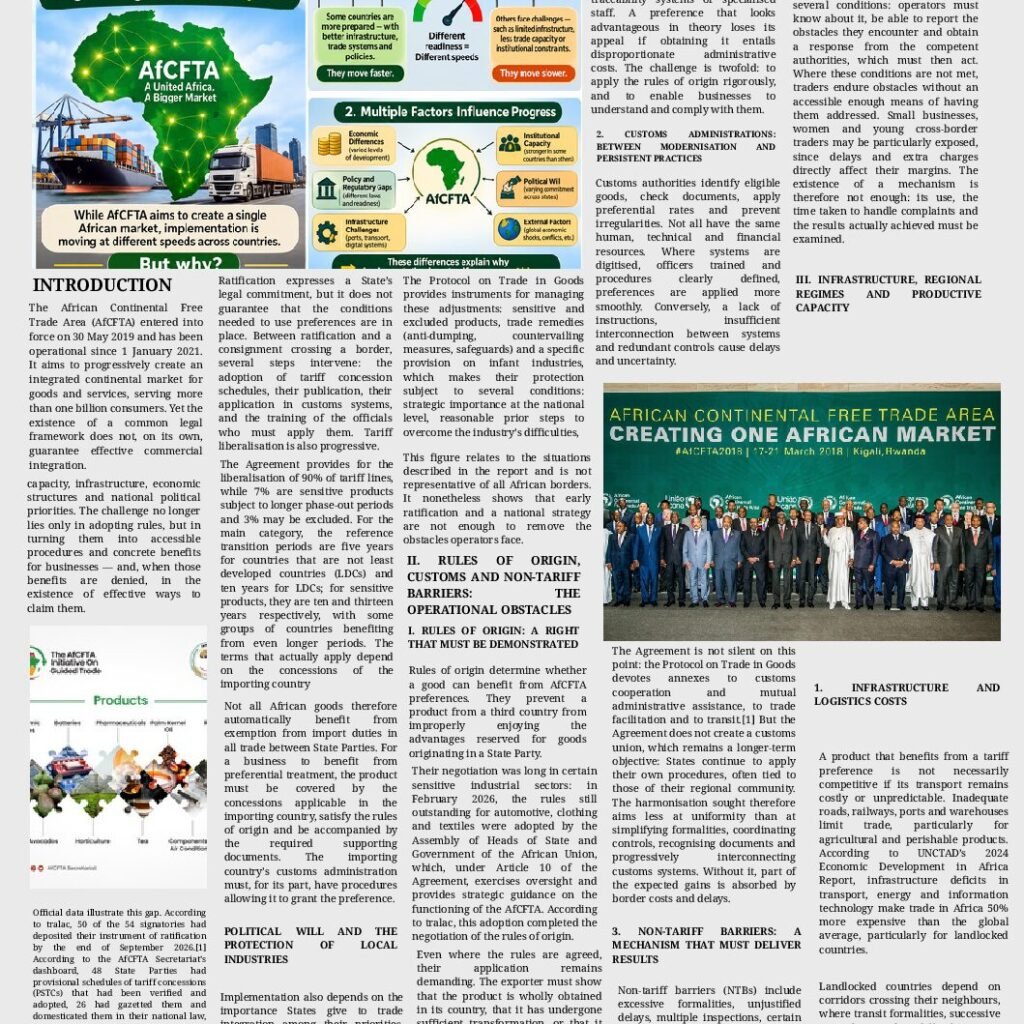
Official data illustrate this gap. According to tralac, 50 of the 54 signatories had deposited their instrument of ratification by the end of September 2026.[1] According to the AfCFTA Secretariat’s dashboard, 48 State Parties had provisional schedules of tariff concessions (PSTCs) that had been verified and adopted, 26 had gazetted them and domesticated them in their national law, and 12 had notified the Secretariat that they were trading under the AfCFTA regime.[2] At each stage, the number of countries falls: joining the Agreement and being able to use its preferences are two distinct things. On the ground, operators face varying difficulties: complex customs formalities, non-tariff barriers, rules of origin that are hard to demonstrate, high logistics costs and limited access to information. This article argues that these gaps result from the interplay between legal commitments, administrative
capacity, infrastructure, economic structures and national political priorities. The challenge no longer lies only in adopting rules, but in turning them into accessible procedures and concrete benefits for businesses — and, when those benefits are denied, in the existence of effective ways to claim them.
I. From Ratification to Effective Application: A Still Uneven Path
Ratification expresses a State’s legal commitment, but it does not guarantee that the conditions needed to use preferences are in place. Between ratification and a consignment crossing a border, several steps intervene: the adoption of tariff concession schedules, their publication, their application in customs systems, and the training of the officials who must apply them. Tariff liberalisation is also progressive. The Agreement provides for the liberalisation of 90% of tariff lines, while 7% are sensitive products subject to longer phase-out periods and 3% may be excluded. For the main category, the reference transition periods are five years for countries that are not least developed countries (LDCs) and ten years for LDCs; for sensitive products, they are ten and thirteen years respectively, with some groups of countries benefiting from even longer periods. The terms that actually apply depend on the concessions of the importing country
Not all African goods therefore automatically benefit from exemption from import duties in all trade between State Parties. For a business to benefit from preferential treatment, the product must be covered by the concessions applicable in the importing country, satisfy the rules of origin and be accompanied by the required supporting documents. The importing country’s customs administration must, for its part, have procedures allowing it to grant the preference.
The Guided Trade Initiative (GTI) illustrates this step-by-step operationalisation. Announced with seven pilot countries, subsequently joined by Tunisia, it was launched in Accra on 7 October 2022. It was intended to enable commercially meaningful trade while testing the operational, institutional and legal environment of the Agreement. According to tralac, 39 State Parties were participating in 2025.[1] A successful pilot does not mean, however, that all businesses in a country can already use the preferences, for all products and to all destinations.
Political Will and the Protection of Local Industries
Implementation also depends on the importance States give to trade integration among their priorities. Ratification must be followed by concrete measures: national strategies, coordination of administrations, monitoring of reforms. Governments must also weigh the expected benefits of opening up against customs revenue and the preservation of certain domestic activities. Greater exposure to competition can weaken local industries whose productivity, access to finance or infrastructure remain limited.
The Protocol on Trade in Goods provides instruments for managing these adjustments: sensitive and excluded products, trade remedies (anti-dumping, countervailing measures, safeguards) and a specific provision on infant industries, which makes their protection subject to several conditions: strategic importance at the national level, reasonable prior steps to overcome the industry’s difficulties, non-discrimination and a specified period.[1] These instruments allow the pace of opening to be adjusted; they do not allow States to depart freely from their AfCFTA commitments. These differences in priorities and capacity to act explain why continental commitments do not translate into commercial results at the same pace everywhere.
An Africa24 TV report from December 2025 on Uganda provides an illustration. The country ratified the Agreement in 2018 and launched its national implementation strategy in December 2024; yet traders report export clearance times of up to 355 hours on certain routes to Kenya, owing to multiple inspections and unharmonised sanitary measures.[1] This figure relates to the situations described in the report and is not representative of all African borders. It nonetheless shows that early ratification and a national strategy are not enough to remove the obstacles operators face.
II. Rules of Origin, Customs and Non-Tariff Barriers: The Operational Obstacles
1. Rules of Origin: A Right That Must Be Demonstrated
Rules of origin determine whether a good can benefit from AfCFTA preferences. They prevent a product from a third country from improperly enjoying the advantages reserved for goods originating in a State Party. Their negotiation was long in certain sensitive industrial sectors: in February 2026, the rules still outstanding for automotive, clothing and textiles were adopted by the Assembly of Heads of State and Government of the African Union, which, under Article 10 of the Agreement, exercises oversight and provides strategic guidance on the functioning of the AfCFTA. According to tralac, this adoption completed the negotiation of the rules of origin.[1]
Even where the rules are agreed, their application remains demanding. The exporter must show that the product is wholly obtained in its country, that it has undergone sufficient transformation, or that it meets another applicable criterion. This requires knowing the product’s tariff classification, keeping records of the raw materials used and obtaining the supporting documents needed to certify origin. More than 12,000 certificates of origin had been issued and notified to the Secretariat by March 2026: the mechanism is therefore being used, although this figure cannot by itself measure the share of intra-African trade that actually benefits from the preferences.
These requirements can be particularly burdensome for small and medium-sized enterprises (SMEs), which do not always have traceability systems or specialised staff. A preference that looks advantageous in theory loses its appeal if obtaining it entails disproportionate administrative costs. The challenge is twofold: to apply the rules of origin rigorously, and to enable businesses to understand and comply with them.
2. Customs Administrations: Between Modernisation and Persistent Practices
Customs authorities identify eligible goods, check documents, apply preferential rates and prevent irregularities. Not all have the same human, technical and financial resources. Where systems are digitised, officers trained and procedures clearly defined, preferences are applied more smoothly. Conversely, a lack of instructions, insufficient interconnection between systems and redundant controls cause delays and uncertainty.
The Agreement is not silent on this point: the Protocol on Trade in Goods devotes annexes to customs cooperation and mutual administrative assistance, to trade facilitation and to transit.[1] But the Agreement does not create a customs union, which remains a longer-term objective: States continue to apply their own procedures, often tied to those of their regional community. The harmonisation sought therefore aims less at uniformity than at simplifying formalities, coordinating controls, recognising documents and progressively interconnecting customs systems. Without it, part of the expected gains is absorbed by border costs and delays.
3. Non-Tariff Barriers: A Mechanism That Must Deliver Results
Non-tariff barriers (NTBs) include excessive formalities, unjustified delays, multiple inspections, certain administrative restrictions, and difficulties linked to sanitary, phytosanitary or technical requirements. They also stem from differing standards across countries and insufficient coordination between the authorities responsible for controls: these obstacles can persist even when customs duties have been reduced.
Annex 5 to the Protocol on Trade in Goods sets up a continental mechanism for reporting, monitoring and eliminating NTBs.[1] Its effectiveness, however, depends on several conditions: operators must know about it, be able to report the obstacles they encounter and obtain a response from the competent authorities, which must then act. Where these conditions are not met, traders endure obstacles without an accessible enough means of having them addressed. Small businesses, women and young cross-border traders may be particularly exposed, since delays and extra charges directly affect their margins. The existence of a mechanism is therefore not enough: its use, the time taken to handle complaints and the results actually achieved must be examined.
III. Infrastructure, Regional Regimes and Productive Capacity
1. Infrastructure and Logistics Costs
A product that benefits from a tariff preference is not necessarily competitive if its transport remains costly or unpredictable. Inadequate roads, railways, ports and warehouses limit trade, particularly for agricultural and perishable products. According to UNCTAD’s 2024 Economic Development in Africa Report, infrastructure deficits in transport, energy and information technology make trade in Africa 50% more expensive than the global average, particularly for landlocked countries.
Landlocked countries depend on corridors crossing their neighbours, where transit formalities, successive controls and difficulties in coordination between administrations lengthen delays and raise costs. Geography alone does not determine trade outcomes, but it imposes constraints that integration must take into account: investment in infrastructure must be accompanied by measures that facilitate transit and coordinate border controls.
2. The Coexistence of Regional Economic Communities
The AfCFTA builds on the achievements of the regional economic communities (RECs), notably CEMAC, ECOWAS, the East African Community, SADC and COMESA, which have their own legal instruments and different levels of integration. Article 19 of the Agreement governs this coexistence. Paragraph 1 provides that, in the event of conflict or inconsistency with a regional agreement, the AfCFTA prevails to the extent of the inconsistency, unless otherwise provided. Paragraph 2, however, preserves the higher levels of integration already attained among member States of other RECs, regional trading arrangements or customs unions.[1] This arrangement makes it possible to build on regional achievements, but it can complicate operations when businesses do not know which regime to apply, which formalities to complete or which documents to present.
3. The Capacity to Produce and Finance Trade
The legal opening of a market does not, by itself, create an exportable supply. Businesses must be able to produce in sufficient quantity, meet standards, finance their operations, arrange transport and find buyers. In undiversified economies, where exports rest mainly on raw materials, the scope to develop regional value chains may remain limited, whereas more industrialised economies are better placed to respond to growing regional demand. Difficulties in accessing trade finance and constraints on cross-border payments can also prevent SMEs from seizing the opportunities of the continental market. Budgetary concerns are another issue: for some States, customs duties are an important source of revenue, which raises questions of fiscal transition. The AfCFTA Adjustment Fund is intended to support the adaptation of economies and to cushion certain effects of trade adjustment, without automatically compensating for all lost revenue.[1] Since countries do not have the same institutional capacities, the same infrastructure or the same economic structures, one and the same agreement can produce different result.
IV. When the Obstacle Persists: Dispute Settlement
The question of remedies is often absent from the debate on implementation, even though it determines the real scope of the rights the Agreement recognises. The AfCFTA has a dispute settlement mechanism, based on Article 20 of the Agreement and a dedicated protocol.[1] It applies to disputes between State Parties concerning their rights and obligations under the Agreement. It follows a graduated logic: mandatory consultations, then, failing settlement within 60 working days of the request, referral to a panel whose report is adopted by the Dispute Settlement Body (DSB). In cases of urgency, notably for perishable goods, the time limits are shortened: consultations within 10 days and the possibility of referring the matter to a panel after 20 days. The report may be appealed, on questions of law only, before a standing Appellate Body that the DSB is to establish under the Protocol. DSB decisions are final and binding. The parties may also agree to resort to arbitration as an alternative route, including as a first resort.
This mechanism has a structural limit for economic operators: a business whose exports are blocked has no standing to bring a case before the DSB itself. It depends on its State’s willingness to take up the matter, which requires a solid file, a political decision and, often, time frames hard to reconcile with those of trade. The mechanism is not, however, disconnected from the field: Annex 5 submits disputes concerning its interpretation or application to the Protocol on dispute settlement, and the Protocol in turn provides that, where an obstacle has not been removed despite the mutually agreed solution and the factual report provided for in the Annex 5 procedure, the requesting State resorts to the panel.[1] In practice, several routes complement one another. An operator can first register a complaint itself in the continental NTB mechanism, which is accessible online: Annex 5 expressly opens this possibility to any economic operator. Where the obstacle concerns a regional economic community, State Parties must in principle exhaust the existing avenues
there before escalating the issue to the AfCFTA level.[1] The operator can also challenge the importing administration’s decision through the administrative or judicial remedies provided for by the applicable national law, whose availability and effectiveness vary from one country to another. Finally, it can ask its trade ministry to raise the matter before AfCFTA bodies or even to initiate the State-to-State procedure. This is where the lawyer plays a decisive role: building the file (certificates of origin, notices of refusal, evidence of delays and costs), identifying the relevant remedy and supporting the business in its dealings with the authorities.
V. Turning Commitments into Results: What Priorities?
Narrowing the implementation gaps requires acting simultaneously on the law, on administrations and on the economic conditions of trade.
- Strengthen political steering: national strategies backed by concrete targets, regular monitoring and support for local industries exposed to competition.
- Make the instruments operational and accessible: gazetted and applied tariff schedules, clear origin certification procedures, and customs instructions that businesses can easily access.
- Modernise and harmonise customs practices: digitalisation, officer training, coordination of controls and recognition of documents.
- Make the NTB mechanism work: raise awareness of it and track the obstacles reported, the responses given and the cases resolved.
- Invest in corridors, logistics and productive capacity, supporting SMEs, women and young people (finance, upgrading to meet standards, information on rules of origin).
- Make remedies accessible: inform operators about national and continental remedies, and strengthen States’ capacity to take up the cases their businesses submit to them.
Conclusion
The AfCFTA cannot be assessed solely by the number of States that have signed or ratified it. Its success depends on States’ ability to turn their commitments into operational instruments, coherent administrative practices and commercial opportunities that businesses can genuinely access. The gaps observed are explained by an accumulation of legal, political, customs, logistical and productive constraints, whose weight varies from one country to another.
In our view, a complete reading of implementation must also take remedies into account. The dispute settlement mechanism gives the Agreement its legal force, but its State-to-State nature creates a gap between the rights businesses can rely on in practice and the means they have to defend them. Closing that gap requires raising awareness of the NTB mechanism, clarifying national remedies and strengthening States’ capacity to take up their operators’ disputes.
For lawyers and international trade practitioners, the role is essential: to clarify the applicable rules, to support operators, to prevent disputes and to identify the available remedies when preferential treatment is refused or an obstacle persists. Only under these conditions can the AfCFTA contribute to a more concrete, inclusive and lasting African integration.